




-250x250.jpg "Wingspan (with Swift Start)")

-250x250.jpg "Heroes Of Barcadia (Retail Edition)")











-250x250.jpg "The Shackleton Series: Box Set (Episodes 1-6)")


















-250x250h.jpg "Weather Machine (French)")
-250x250.jpg "The Great Wall (Kickstarter Dragon Pledge)")
![Reavers Of Midgard [Used]](https://www.boardgamesnmore.com/image/cache/wkseller/2156/OIP%20(24)-250x250h.jpg "Reavers Of Midgard [Used]")
![frostgrave forgotten pacts [Used]](https://www.boardgamesnmore.com/image/cache/wkseller/2156/frostgrave%20forgotten%20pacts-250x250.jpg "frostgrave forgotten pacts [Used]")
![Shadows Of Brimstone [Used]](https://www.boardgamesnmore.com/image/cache/wkseller/2156/shadow%20of%20brimstone-250x250w.jpg "Shadows Of Brimstone [Used]")
![fallout wasteland warfare 2 player starter set [Used]](https://www.boardgamesnmore.com/image/cache/wkseller/2156/fallout%20wasteland-250x250.jpg "fallout wasteland warfare 2 player starter set [Used]")
![Final Girl Set [Used]](https://www.boardgamesnmore.com/image/cache/wkseller/2156/final%20girl-250x250w.jpg "Final Girl Set [Used]")
![lotus [Used]](https://www.boardgamesnmore.com/image/cache/wkseller/2156/lotus-250x250w.jpg "lotus [Used]")
![shadow of brimstone other worlds derelict ship expansion [Used]](https://www.boardgamesnmore.com/image/cache/wkseller/2156/shadow%20of%20brimstone%20derelict%20ship-250x250.jpg "shadow of brimstone other worlds derelict ship expansion [Used]")
![shadow of brimstone other worlds blasted wastes deluxe expansion [Used]](https://www.boardgamesnmore.com/image/cache/wkseller/2156/shadow%20of%20brimstone%20blasted%20wastes-250x250.jpg "shadow of brimstone other worlds blasted wastes deluxe expansion [Used]")
![pathfinder lost omens world guild [Used]](https://www.boardgamesnmore.com/image/cache/wkseller/2156/pathfinder-250x250.jpg "pathfinder lost omens world guild [Used]")
![frostgrave the wizards conclave [Used]](https://www.boardgamesnmore.com/image/cache/wkseller/2156/u-IcDKRc7zgddJ2Mrrms2PBHL9UJBNeuMkaOUOc_pD3_ytpZWUCk4IsnBnQUzBdkXAWlUxi6nkIu--24EnEMQR4Ftx9PidTveq9xL4GZ_WizRTQZF5NRQlz6BKFtgntac3t6Af9zTsbJqWJ_YKD1YV2Op4WPYWbncT_Srt6teTVjB5-YgKKtzdS5WjCqkSuo-250x250.jpg "frostgrave the wizards conclave [Used]")
![frostgrave the frostgrave folio [Used]](https://www.boardgamesnmore.com/image/cache/wkseller/2156/mSLxH3h5nLQyoq3R42LI0S01fOQoe61AML6gKSERWcBvRL-XN_dxyS88WIJ77X5Mz2Ilub8mZa7AqYjSOltGyrG2kI1f-T-OEEM0tK6pSQWfybshdBUefG2UUoL5ZdZSiZYvZ4T3vL8zNMU0I0AC9COnS5z2gfc_v8M7qP7UcC6KzNoN4ZIzqi-ecKdAjHwD-250x250.jpg "frostgrave the frostgrave folio [Used]")
![frostgrave second edition fantasy wargames in the frozen city [Used]](https://www.boardgamesnmore.com/image/cache/wkseller/2156/EcGTsEqoG40gx2K9BLAK6pQZovo9dOMTsU40GX1c4_Ju4IBButTAUYpB4emm53JxVwZ9VvyH2QBbVo2CB72qii3_T0p_Fjb8GG9TjEAXxRhGKqniw-PanWzZgtzr9IlMuIqftLjkb7PvFek21HdI-mUztqt1MfPP-i9zcFFMR6R0wULWaphxl6uVgRYYysao-250x250h.jpg "frostgrave second edition fantasy wargames in the frozen city [Used]")
-250x250h.jpg "Fall of the Mountain King (Kickstarter Edition)")
-250x250w.jpg "Intrepid (KickStarter Edition)")

The group chat says “come over.” Someone puts a box on the table. Twenty minutes later half the room is on a phone, because the game feels like a kids’ birthday, needs an hour of rules, or is mean in a way that makes two people quit. A good board game for teenagers does the opposite. It teaches in a few minutes, gives everyone a job, and stays funny without making the quietest person the joke.
This guide is for parents, older siblings, and teens hosting the night. The German search terms behind it are gesellschaftsspiel jugendliche, gesellschaftsspiele für jugendliche, and lustige spiele: a parlor game for teens, board games for teenagers, and funny games. The boxes below are sold by BoardGamesNMore, a board-game shop in Montreal. Prices and stock change. Check the product page before you buy.
A teen game is not a kids’ game with a bigger box
Between 12 and 17, what a table will tolerate changes fast. A game marked 8+ can still be the right one if the choices are real and the jokes are not written for a six-year-old. It fails when the task is only “point at a picture” and nobody risks anything. Teenagers notice immediately when a game talks down to them.
The heaviest strategy box is rarely the fix. Dropping a 90-minute economic game on a group that has never finished a rulebook usually ends with people drifting off. The useful middle is a round with one clear decision, a result people still quote while someone gets snacks, and an ending that arrives before the night does.
Screen time is the background, not a lecture you can win. Pew Research Center surveyed 1,458 U.S. teens ages 13 to 17 between September 25 and October 9, 2025. Ninety-seven percent use the internet daily. About one in five say they are on TikTok or YouTube almost constantly, and 64 percent use AI chatbots, with roughly three in ten doing so daily (Pew Research Center, 2025). An earlier Common Sense Media census put average daily screen media for ages 13 to 18 at 8 hours 39 minutes in 2021 (Rideout, Peebles, Mann & Robb, 2022). None of that proves a board game replaces a phone. It does explain why a night with a start and a finish has become rare.
The research on teens and tabletop play is narrower than marketing copy suggests. A 2025 paper in Discover Education found that after playing one educational board game, students rated communication and sharing resources as more important than they had before (Springer Nature, 2025). Noda, Shirotsuki, and Nakao (2019) reviewed studies of board-game interventions and psychosocial outcomes (BioPsychoSocial Medicine). A program in residential care in Spain, Germany, and Poland found something more specific: after months of weekly play, educators rated young people’s skills more positively, while the adolescents’ own self-ratings stayed similar (Gallardo-Masa et al., 2024). Useful. Not a personality overhaul. Buy the game because the evening gets better.
The smallest version that already works
If you only want one decision, pick a funny game that teaches in under 20 minutes, seats the people who will actually stay, and puts the punchline where the whole table can see it.
For a short, silly start, Exploding Kittens is the small version. Two to five players, listed at 7+, about 15 minutes, priced at 29.99 CAD on the shop page. You draw until someone hits the exploding kitten. Along the way you peek, shuffle, or shove cards onto a friend. The art is absurd, not explicit. For a bigger and even faster table, Ninja Hamster Apocalypse Disco fits three to ten players, 7+, about ten minutes. Dump your cards first and answer the action cards faster than everyone else. Neither box is a special “teen edition.” They work for teenagers because the pace, and the small betrayals between friends, carry the tension.
If the group would rather talk than slap cards, the smallest good version is a word game. That comes next. First, the three filters that keep a recommendation from being a guess.
Three filters before you buy a box
Age: 10+, 12+, 14+, 16+
The number on the box is a publisher’s suggestion, not a maturity exam. Codenames shows how far those numbers drift. BoardGamesNMore lists it at 14+. Czech Games Edition says 10+, and Spiel des Jahres revised its recommendation from 14+ on early editions to 10+ (Spiel des Jahres: Codenames, Czech Games Edition). The content is not edgy. It asks for vocabulary and a willingness to share an association. A 12-year-old table that likes words often does better than a 16-year-old table that does not want to talk.
The reverse is also true. An 8+ mark does not mean “too young.” Dixit is recommended from age 8 on the Spiel des Jahres page and won that award in 2010 (Spiel des Jahres: Dixit). The cards still hold an older group because every clue is invented at the table. The joke comes from the players, not from a line written for eight-year-olds.
At 14+, pay attention when the game judges people. Raise Your Red Flag is listed at 14+, for 2 to 20 players, about 30 minutes, at 21.99 CAD. You assign flags to statements such as who thinks they are a social-media influencer. That is an icebreaker. In a group that barely knows each other, it is funny. In a group where one person is always the punchline, it gets sharp quickly. Read two or three cards out loud before the first night. If someone already flinches, it is the wrong game for that room, even if the age on the box matches.
At 16+ and 18+ you are in another category. The Inappropriate Workplace is listed at 16+, in the style of a rude answer-card game built on workplace situations. That is not a board game for a mixed teen group that includes 13-year-olds, and it is not a casual gift for a whole class. If you are shopping for funny games and younger teens are at the table, leave that box on the shelf.
Player count: the number of people who will stay
Plan for the people who remain, not for the friend who might show up later. A lot of funny games break when a sixth person sits on the couch and only watches.
2 to 4: Azul, The Mind, EXIT: The Game – Family, Catan: Family Edition
4 to 8: Dixit, Codenames, Sushi Go Party!
8 to 12: Telestrations: 12 Player Party Pack, You Can't Say "Umm"
Up to about 18 or 20: Time's Up!, Raise Your Red Flag
The Dixit product page says 3 to 8 players. The Spiel des Jahres page describes the classic game as 3 to 6. If your group is regularly eight, check which edition is in the box before you count on every seat.
Time: 15 minutes is a feature
A school day, practice, and a phone in a pocket rarely survive a game that “really starts” after 40 minutes of setup. Short games stack. Two rounds of Exploding Kittens and then a word game beat a two-hour block nobody finishes.
Stock moves. When this guide was researched, Codenames, the Telestrations party pack, and Ticket to Ride were out of stock, and several other titles were not. The product page is the current source, not this table.
Funny games for the loud night
Funny games for teenagers need a punchline the whole table sees. Secret points revealed at the end produce fewer laughs than a drawing that mutates from “astronaut” to “toaster” on its way around the room.
Telestrations: 12 Player Party Pack is telephone with a pencil. One person sketches a word, the next guesses, the next sketches the guess. At the end the chain is on the table, and nobody has to draw well. The crooked sketch is the joke. Four to twelve players, 12+, about 30 minutes. For birthdays where more than eight people are standing in the living room, this is one of the few funny games that does not turn half the guests into an audience. Embarrassment about drawing usually dies at the first reveal, because the worst sketch gets the biggest laugh.
You Can't Say "Umm" is the loud, short alternative. Four to twelve players, 10+, 15 to 20 minutes, listed at 29.99 CAD. Teams work through word cards and challenges, and every “umm” rings a bell. It hits the same pleasure as German party games built on forbidden words: the sentence is easy, the mouth is not. For teenagers who want to show off without learning a rules brochure, this is a better open than any game with a symbol key.
Time's Up! stretches that impulse across a whole night. Four to 18 players, 12+. In three rounds you describe the same names, then cut the clues down, then act them out with no words at all. Round one feeds round three. A sloppy explanation early becomes arm-waving later. The product page lists about 90 minutes. For a birthday with a crowd, that is the main event, not a warm-up. Plan a break, or the energy drops after round two.
Raise Your Red Flag and Exploding Kittens cover the other two poles. Red Flag is conversation. Kittens is speed and a little sabotage. If you do not yet know whether the group wants to talk or to needle each other, play one short round of Kittens or Ninja Hamster first. You will see whether they want a talking game next or just another hand of cards.
A practical test before you buy: can you explain the game in three sentences while someone is still hanging up coats? If not, it is the second game of an open teen night, not the first.
Word games and team games for a group that likes to talk
Some teenagers do not want to draw, and they do not want the fastest hand. They want to say one sentence and watch the table decide whether it was brilliant or a miss. Team word games are that drawer.
Codenames is still the reference. Two teams, one spymaster each, a grid of words. The spymaster gives one word and a number. “Tree, three” might mean bark, trunk, and apple, and it must not touch the assassin or the other team. A wrong guess ends the turn. Spiel des Jahres describes the pull accurately: one game is often followed by a second, then a third (Spiel des Jahres). The shop page lists 2 to 8 players, about 15 minutes, 30.99 CAD. For teenagers the appeal is not “we are spies.” The appeal is that the quiet person with the good clue is suddenly the most important one at the table. The person giving clues talks less and thinks more. That flips the usual party hierarchy.
Just One is the cooperative counterpart, and it won Spiel des Jahres in 2019. Three to seven players, age 8+, about 20 minutes (2019 award booklet). One player guesses a word. Everyone else writes a clue at the same time, with no discussion. Duplicate clues are thrown out. If you think the same thing as the person beside you, you do not help. You erase a clue. It sounds strict and plays generously, because every round is a small success. For mixed ages, Just One is often kinder than Codenames. Nobody sinks a whole team with one bad guess, and it is easy to watch if someone arrives late.
Dixit sits between guessing and storytelling. One player offers a sentence, a lyric, or a single word for a picture card. Everyone else plays a card that might also fit. The table then votes on which picture was the real one. If the clue is too obvious, everyone scores and the storyteller scores nothing. If it is too strange, nobody understands it, and the storyteller scores nothing again. The product page lists 3 to 8 players, 8+, about 30 minutes, 51.99 CAD, and a 7.2 out of 10 rating. For teenagers who like images and dislike rule text, Dixit is often the board game they will set up a second time without being asked. The wooden rabbits on the scoring track are secondary. The night runs on sentences nobody expected.
These three games work for school groups, friend groups, and families where parents play without setting the pace. They do not work for a table that wants stand-up comedy at one person’s expense. They were not built for that, and that is a strength.
Cooperative play, and games with a hidden traitor
Not every teen group wants a winner. Some nights are better when everyone is allowed to lose together.
The Mind, by Wolfgang Warsch, is the most radical short example. Two to four players play number cards in ascending order without saying what they hold. You look at each other and play when it feels right. A mistake costs the group a life. The game was nominated for Spiel des Jahres in 2018, the year Azul won. For teenagers, The Mind is less a “game” than a bet that the group can find a rhythm. It does not last long. It works as an opener before something louder, and it fails honestly. Either you share the impulse or you do not. People laugh about that afterward more often than they argue.
EXIT: The Game – Family: 2 Escape Adventures is the other cooperative pole. One to four players, 8+, 45 to 75 minutes, listed at 33.99 CAD, published by KOSMOS. Two puzzle adventures, with a lighter family tone. For four teenagers on a rainy afternoon, it is a closed program: you start, you finish, you solved it or you did not. The family line is deliberately more accessible than the harsher EXIT cases. If your group already loves escape rooms and has cleared several, this box will feel easy. If this is their first shared puzzle, that is the point.
Hello Neighbor: The Secret Neighbor Party Game changes the color. Five to ten players, 8+, about 30 minutes, listed at 23.99 CAD. Most players are kids hunting for keys. At least one person is the Neighbor, and another is a secret Neighbor inside the group. Trade, lie, vote. For teenagers who know Werewolf, Among Us, or traitor episodes of a series, this is that suspicion in a box. It needs at least five people. At four, there is not enough cover for a lie to hide in.
Cooperative games have a social side effect groups underestimate. When you lose, you lose together. That takes the night out of the pattern where the competitive kids win and everyone else watches. It also requires that nobody solves every clue alone. Say so before you start. “We say every find out loud” is a house rule that saves EXIT sessions with teenagers.
The next step when party games are not enough
Eventually someone says, “Can we play something where you actually plan?” That is the moment for a gateway game, not a three-hour campaign.
Sushi Go Party! is the gentle threshold. Two to eight players, 8+, about 20 minutes, 37.99 CAD, with a 7.4 out of 10 rating on the product page. You pass cards and collect sets: maki, sashimi, tempura, and in the party edition you choose which dishes are even in the game. The decision is real, the teach is short, and the round ends before attention does. For teenagers who say they do not like board games and then demand a third round, this is a reliable signal.
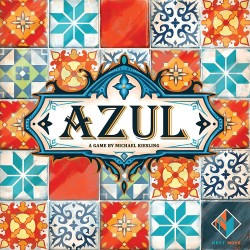
Azul is the next clean step, and it won Spiel des Jahres in 2018. Two to four players, age 8+. The shop lists 30 to 45 minutes and 56.99 CAD. The jury page says about 45 minutes and a medium entry level (Spiel des Jahres: Azul). You draft colored tiles from shared plates and build a pattern. Take too many and you lose points. The pieces feel like more than a card game. The rules still fit on a page. For two to four teenagers who get restless at party games because “we’re only messing around,” Azul is often the one they want to keep. It is quieter. It is fair. It still produces a small shout when someone takes the color you needed for a column.
Ticket to Ride opens the map. Two to five players, 8+, 30 to 60 minutes. Alan R. Moon kept the rules short enough to fit on a ticket: draw cards, claim a route, or take new destination tickets. The tension is that you cannot do all of it. A long route scores points and can cut someone else off. For teenagers this is often the first game where a plan lasts more than one turn, without a rules video. The shop describes it as the classic gateway game, and that reputation is earned.
Catan: Family Edition is the familiar island in a version the shop lists at 10+, for 3 to 4 players, 60 to 90 minutes, at 39.99 CAD. Trade, build settlements, dodge the robber. The Family Edition is not the big base box with every expansion. It is a closed evening for a small group that already likes Sushi Go or Ticket to Ride and now wants to negotiate. It does not work under three players. Do not plan it for a tenth-birthday crowd of ten.
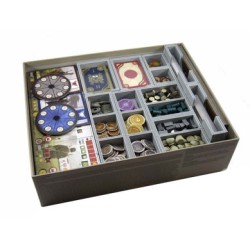
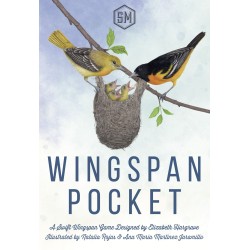
Wingspan (with Swift Start) is the step after that, not before. Elizabeth Hargrave’s card game about bird habitats won the Kennerspiel des Jahres in 2019: more depth, still teachable, no longer “while the pizza is on the way.” The Swift Start pack is there to shorten the first game. For older teenagers who have already played Azul several times and want a longer, prettier decision, look through the Stonemaier games at BoardGamesNMore. For a first open game night, it is too much game and not enough party.
The order that works in practice: a funny game while people arrive, a word or team game while everyone is there, and a strategy game only if the same four people are staying. Opening with Wingspan or Catan while the doorbell is still ringing spends the first half hour on rules.
Four groups, four games
Two to four people, on the quieter side. Azul or The Mind. If you want puzzles, EXIT Family. If you want a full evening and you are exactly three or four, Catan Family Edition. Funny games at this size are Exploding Kittens and, if you like pictures, Dixit.
Five to eight, the classic teen table. Codenames or Just One to open, Dixit if the group thinks in images, Sushi Go Party if someone asks for “a little tactics.” Hello Neighbor once you have at least five and want suspicion.
Nine to twelve, a birthday. Telestrations Party Pack or You Can't Say "Umm." Time's Up if you are willing to give the night to one game. Raise Your Red Flag if not everyone knows each other and you want conversation that is not intimate. Read the cards first.
Mixed ages, parents plus teenagers. Just One, Dixit, Sushi Go Party, Azul, Ticket to Ride. Skip games whose joke depends on singling someone out, and skip 16+ card games while younger siblings are in the room. A board game that makes a 14-year-old and a parent look equally foolish is usually the right one.
What to wrap as a gift
Do not ask “do you like board games?” Ask what happened the last time people came over.
They laugh at drawings and chaos: Telestrations or Exploding Kittens.
They argue, quote, and correct each other: Codenames or Just One.
Two close friends play as a pair or a foursome and want something good-looking on the table: Azul or Dixit.
It is a birthday with a crowd and a short attention span: You Can't Say "Umm" or Raise Your Red Flag.
They are bored of app rounds and asked for “an actual game”: Ticket to Ride, then Catan Family Edition.
A gift works when the person can teach it without you. Write one sentence on the card: “Teaches in five minutes, plays at four, you will want a second round.” That helps more than any age rating.
Roughly sorted by the listed prices: Raise Your Red Flag and Exploding Kittens sit around 20 to 30 CAD. You Can't Say "Umm," EXIT Family, Hello Neighbor, and Catan Family Edition cluster up to about 40 CAD. Dixit, Azul, Sushi Go Party, and Telestrations sit higher. If you do not know the group size, a game that seats at least six to eight is harder to get wrong than a strict two-player duel.
What usually goes wrong
The game is smart and the table is tired. A hobby game after 9 p.m. on a school night loses to anything that ends in ten minutes. Flip the order. Play the short funny game first. The heavier game deserves a different night.
One person teaches, and it becomes a lecture. For Codenames, this is enough: “One word, one number, do not hit the black card.” Play the first round with mistakes allowed. Rules that only matter in round three do not belong in the opening speech.
The humor hits one person, not the room. Icebreakers and rude answer games are funny only when anyone can decline. Set a card aside without a debate. Treating that as silly has already made the night worse.
Too many new games in one night. Two boxes are enough. Three, if the first one truly lives for 15 minutes. A stack of untaught games on the dresser is not a plan.
The age number gets treated like doctrine. A sharp 11-year-old table can play Codenames. A 17-year-old table can have more fun with Dixit than with a 16+ game whose only joke is shock. You know the people. The box does not.
Questions people ask before they buy
What is a good board game for teenagers around 12? You Can't Say "Umm," Telestrations, Time's Up, Dixit, Just One, and Sushi Go Party are sensible starts. They teach quickly and do not sound like a children’s party. Codenames often fits the language earlier than the shop’s 14+ mark suggests.
Which funny games work with a crowd? Telestrations up to 12, You Can't Say "Umm" up to 12, Time's Up up to 18, Raise Your Red Flag up to 20. Hello Neighbor needs at least 5 and plays up to 10.
What is the difference between a parlor game and a party game? In German search, Gesellschaftsspiel and Partyspiel often point at the same evening. Party game stresses speed, laughter, and few rules. A parlor or board game can be that, or it can be a longer game with a plan. For teenagers the better question is not the category. It is whether tonight should be loud or built.
How long should the first night be? Ninety minutes of play, not ninety minutes of a rules video. A 15- to 30-minute game, played twice, fills an hour and leaves room for a second box.
Can these be used at school or in a youth group? Just One, Dixit, Codenames, Sushi Go Party, Azul, and The Mind, yes, once a supervisor has seen the cards. Rude 16+ party games, no. With Raise Your Red Flag, check whether the statements fit that group.
Does the game need to be in English? Many titles at this shop are in English. Codenames, Just One, and Time's Up depend on wording. Dixit, Azul, Exploding Kittens, The Mind, and Sushi Go Party travel further in a mixed-language group because pictures and icons do a lot of the work. If the table does not want to read English, say so before you buy and pick a game that leans on images or symbols.
A night that holds
A board game for teenagers does not have to improve anyone. It has to create the moment when someone looks up from a phone because the drawing went sideways, or because one word hit three cards at once. Games for this age work when age, headcount, and time agree. Funny games work when the joke lands on the whole table.
If you are only taking one box today: for four to six people who like words, Codenames or Just One. For a big, loud room, Telestrations or You Can't Say "Umm". For two to four people who already want more, Azul. The rest of the shelf, from party boxes to the longer Stonemaier games, is at BoardGamesNMore.
Play one round. Ask if they want another. That is the only review that matters for your group.
Sources
Pew Research Center. (2025). Teens, Social Media and AI Chatbots 2025. Survey of 1,458 U.S. teens ages 13–17, September 25–October 9, 2025. PDF
Rideout, V., Peebles, A., Mann, S., & Robb, M. B. (2022). The Common Sense Census: Media Use by Tweens and Teens, 2021. Common Sense Media. PDF
Springer Nature, Discover Education. (2025). Adolescents’ knowledge of and confidence in vaccines improves with board game play. Article
Noda, S., Shirotsuki, K., & Nakao, M. (2019). The effectiveness of intervention with board games: a systematic review. BioPsychoSocial Medicine, 13, 22. DOI
Gallardo-Masa, C., Sitjes-Figueras, R., Iglesias, E., & Montserrat, C. (2024). The impact of a board game program on residential care. Children and Youth Services Review. DOI
Spiel des Jahres. Codenames. Game page
Spiel des Jahres. Dixit. Game page
Spiel des Jahres. Azul. Game page
Spiel des Jahres. (2019). Award booklet featuring Just One, Spiel des Jahres 2019. PDF
Czech Games Edition. Codenames (2015), age 10+. Publisher page
Player counts, ages, times, prices, and ratings come from the linked product pages on boardgamesnmore.com. They can change. This is a buying guide, not a manufacturer description.




_-250x250w.jpg "Final Girl S4 Terror From Beyond Miniatures (Vignette)")


-250x250.jpg "Star Wars: Legion: Clone Commander Cody (ML)")






Leave a Comment